A SOC 1 examination can offer an independent evaluation of certain controls for an organization whose services have an impact on its customers’ financial reporting.
Businesses outsource functions like payroll, payment processing, claims handling, data management and accounting assistance. They want to be confident that the right controls exist on financial reporting. SOC 1 attestation services help businesses streamline their financial reporting. The services are provided by an independent CPA firm in accordance with the appropriate professional standards.
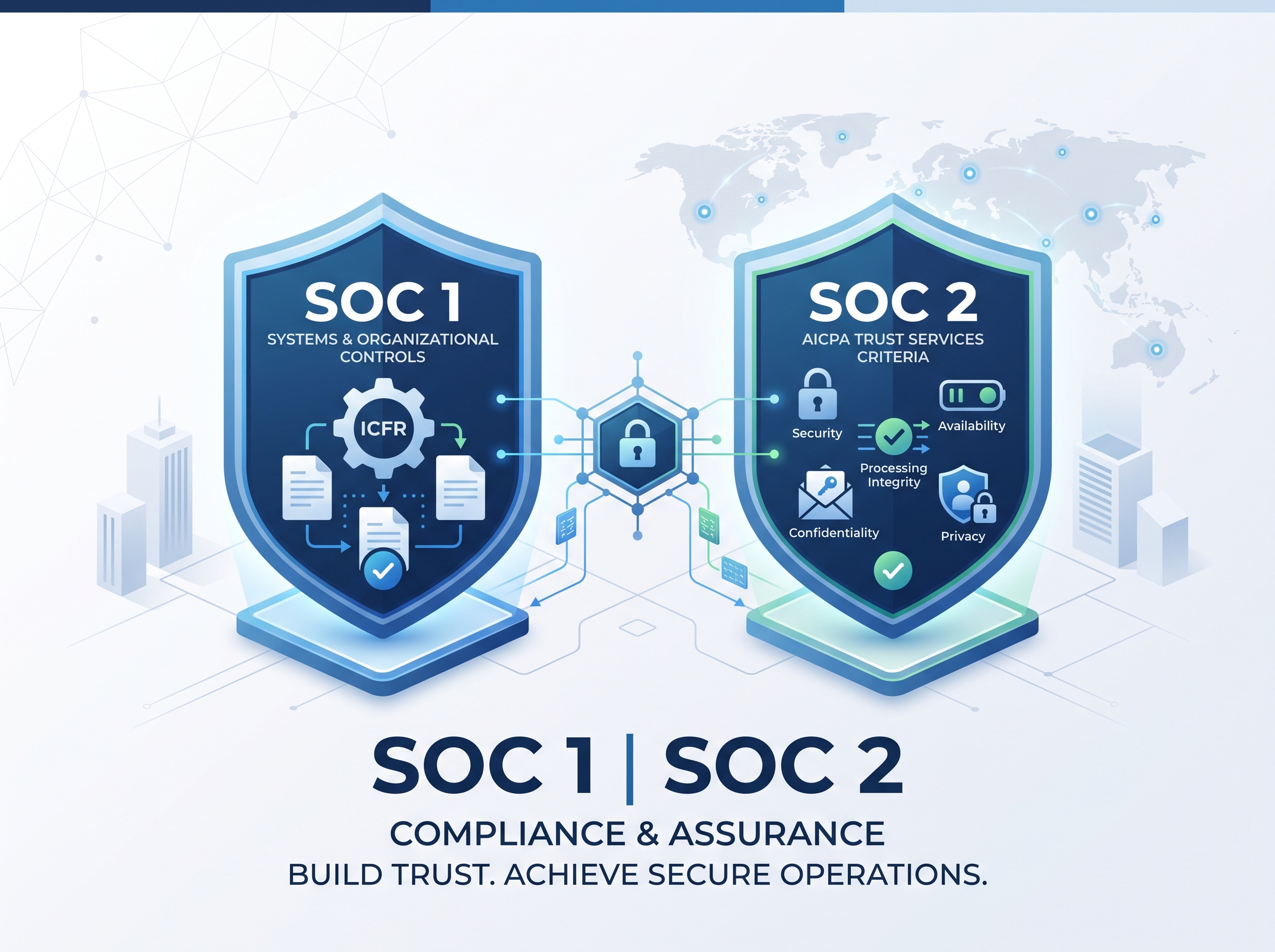
SOC 1 is a component of the System and Organization Controls (SOC) suite of reports established by the American Institute of Certified Public Accountants (AICPA). SOC 1 reports concentrate exclusively on controls at a service organization that impact its clients’ internal controls over financial reporting.
A SOC 1 engagement can result in either a Type 1 or Type 2 report.
A Type 1 report assesses the suitability of the design and implementation of controls at a specific point in time. A Type 2 report further assesses whether the identified controls were functioning effectively for a predetermined time period.
The report delivers information that customers and their auditors can rely upon while assessing risks related to their outsourced services.
1. Identifies Financial Reporting Risks
SOC 1 attestation services identify processes and controls relevant to the financial reporting of its customers during the scoping and planning phase of a SOC 1 examination. These processes and controls may be relevant to transaction processing, access management, change management, data integrity, or other areas, depending on the nature of the services provided.
2. Establishes Clearly Defined Controls
For reliable financial reporting, organizations need well-defined controls. Preparing for a SOC 1 review can help businesses record key procedures and clarify who is responsible for each one. When expectations are written down, staff are better equipped to carry out their duties, and managers can more easily check that the controls are working properly.
3. Strengthens Access Controls
Accessing systems without authorization can also pose risks related to financial data and transaction processing. SOC 1 attestation services address controls related to logical access if those controls are relevant to the service commitments and system aspects being examined. Organizations can define procedures to grant, change and revoke access rights to the users based on roles.
4. Improves Change Management
Changes to applications, databases and IT infrastructure can impact the integrity and reliability of information processed by a service organization. A structured change-management process may require changes to be approved, tested and documented before being implemented into a production environment.
5. Promotes Reliable Transaction Processing
SOC 1 attestation services act as payment processors for their clients. Mistakes in these processes could have an impact on a customer’s financial information. Relevant controls could be: validation checks, reconciliations, exception reports and managements reviews. The nature of the controls is defined by the service and the associated risks.
6. Encourages Better Documentation
In a SOC 1 examination, entities normally have to demonstrate the operation of relevant controls. This incentivizes companies to keep proper documentation, including review evidence, access reports, approval records and system logs when feasible. Improved documentation also facilitates the management to investigate control exceptions and show that corrective actions were taken.
7. Identifies Control Gaps
SOC 1 attestation services reveal vulnerabilities in an organization’s control environment. If testing reveals exceptions, management can look into the situation and decide if corrective action to the extent of the exceptions is necessary. These may include changes in policies and procedures, technology or the duties of employees.
8. Provides Useful Assurance to Customers
Consumers usually have questions about the controls run by their service providers. Rather than each client performing their own evaluation of the identical service provider, SOC 1 reports may enable them to simply gain pertinent information about the controls of the service organization.
9. Supports Auditor Assessments
The controls of service organizations may also need to be taken into account by the customer’s external auditor in a financial statement audit of the customer. SOC 1 attestation services can be a source of information for the auditor about pertinent controls at the service organization.
10. Encourages Continual Control Improvement
SOC 1 engagements can prompt organizations to review and reassess their control environment from time to time and recognize potential for enhancement. Findings from the examination and information on performance of controls can be used by management to improve processes and to correct exceptions identified.
Conclusion
SOC 1 attestation services can enhance financial reporting controls by allowing service organizations to focus on (a) identifying pertinent risks, (b) implementing well-defined controls, (c) upgrading documentation, and (d) assessing the effectiveness of critical processes. The control environment may include activities such as access management, change management, and associated risks.