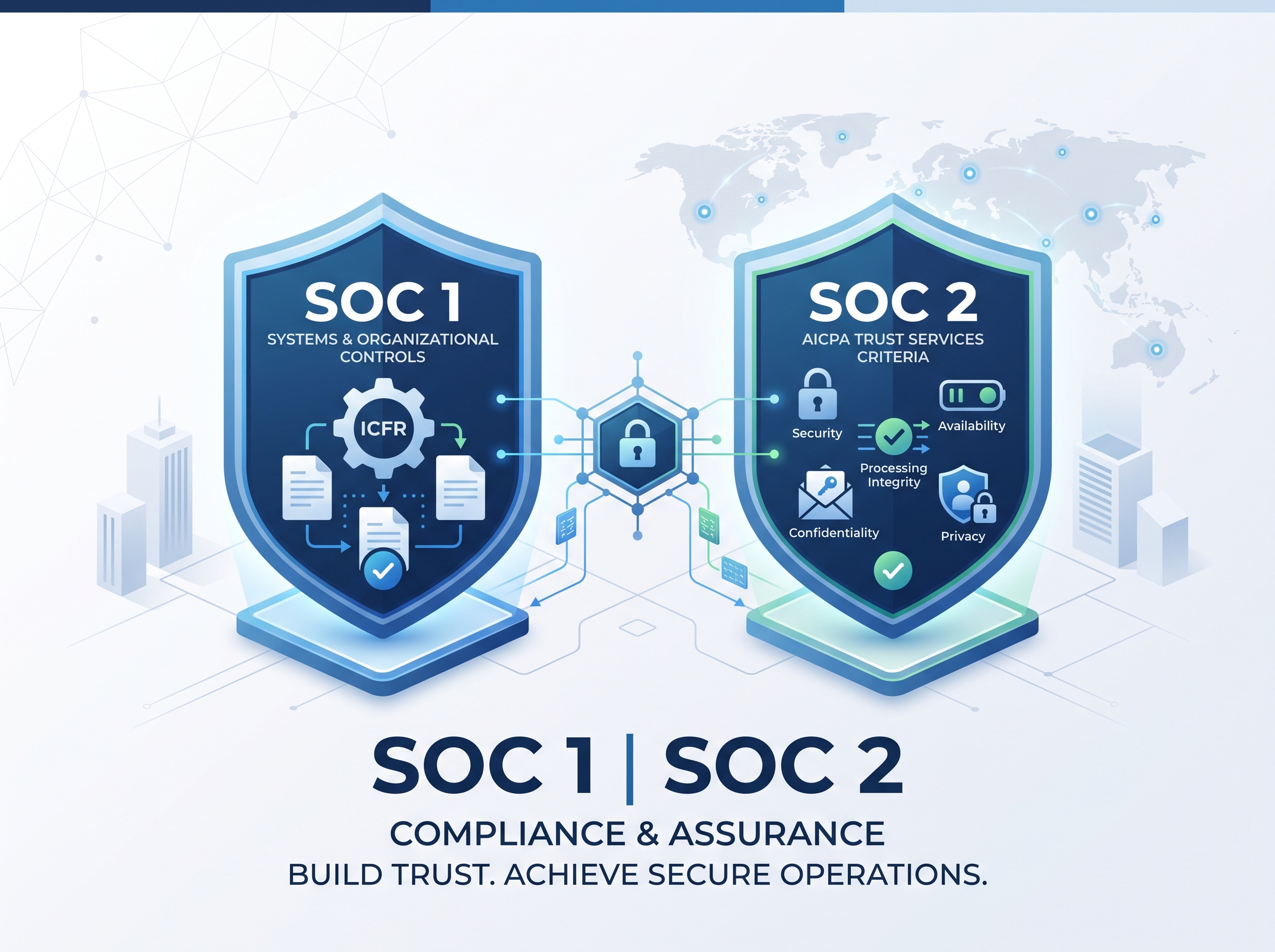

SOC 1 attestation can assist service organizations in demonstrating the effectiveness of controls relevant to their customers’ internal control over financial reporting (ICFR). In addition to the independent report, the process of preparing the report can prompt organizations to identify weaknesses, formalize processes, improve accountability and implement more standardized financial controls.
What Is SOC 1 Attestation?
SOC 1 is a review of controls at a service organization that impacts the customer’s financial reporting. The engagement is conducted in accordance with the professional standards of an independent CPA practitioner.
A SOC 1 report may be either Type 1 or Type 2 report. Controls in a Type 1 report are reviewed for design and implementation as of a point in time. A Type 2 report additionally tests the operating effectiveness of identified controls during a defined time frame.
Identifying Financial Reporting Risks
SOC 1 attestation can help to improve financial controls by encouraging organizations to identify risks that may impact financial reporting.
For instance, a firm handling financial transactions may run the risk of inaccurate data, unauthorized transactions, incomplete records, system changes or processing mistakes. Management can analyze these risks in a structured manner to identify which controls would need to be put in place to mitigate them.
Establishing Clearly Defined Controls
Financial controls are built on clear processes and responsibilities. SOC 1 preparation prompts organizations to write down what controls they have in place, who is responsible for them, how often they are performed, and how they can prove that the control has been completed. Controls can include transaction approvals, account reconciliations, access reviews, exception handling, change-management processes, and management reviews.
Improving Segregation of Duties
The separation of duties is also a crucial factor to be considered to establish efficient financial control. When an excessive degree of control is vested in a single person, the potential for errors or misfeasance increases. In the course of SOC 1 attestation, an entity might examine who has access to systems, who is permitted to authorize transactions, who reconciles and who examines financial data.
Strengthening Access Controls
Financial data and systems should be exposed to and accessed by only trusted parties. SOC 1 readiness can motivate organizations to develop tighter user-access controls. These could be new hire and termination workflows, role-based access, regular access audits, and protocols for revoking access when personnel move roles or exit the company.
Improving Change Management
Information technology systems often underlie financial processing. Thus, modifications to applications, databases, integrations, and infrastructure may impact the correctness and dependability of financial data.
An SOC 1 control environment might include policies such as changes must be authorized, tested, documented, and implemented. A well defined process for change management also helps minimize the risk of an unauthorized or ill-tested change causing financial processing to be interrupted or leading to the generation of incorrect results.
Creating Better Audit Evidence
A control is more effective when an organization can show that it was executed. SOC 1 attestation can thus encourage companies to put in place repeatable processes for keeping evidence.
Examples of evidence are approval records, reconciliation documents, access review outcomes, system reports, tickets, logs or management sign-offs. Proper evidence can help management, customers, and auditors more readily grasp how controls function.
Encouraging Consistent Processes
Companies sometimes lean on employees’ expertise and tacit knowledge to perform critical financial processes. That might work when the company is small, but that mindset can create problems as it grows.
SOC1 readiness can be a catalyst for organizations to bring key processes out of the shadows. Documented processes offer employees guidance for how work should be performed and what to do if exceptions are encountered.
Supporting Continuous Improvement
SOC 1 attestation is not something to consider as a one-off compliance activity. The process can provide a foundation for continuous improvement within the organization.
Having identified control weaknesses, management can assign responsibility for correction, set deadlines and track progress. Subsequent reviews can then evaluate whether controls are still appropriate given changes in the business, technology and customer needs.
SOC 1 Type 1 vs. Type 2
A Type 1 report expresses an opinion on the fairness of the presentation of the description of controls and the suitability of the design and implementation of controls at a specific date. This report can be helpful for organizations that are just building their control environment or are in the early stages of reporting on SOC.
A Type 2 report evaluates the design of controls and their operating effectiveness over a period. Customers may find this report especially useful when evaluating an existing service provider, as it provides evidence that controls have operated over time.
Conclusion
SOC 1 attestation may help enhance financial controls, as it prompts organizations to recognize risks to financial reporting, delineate roles and responsibilities, enhance access controls, document procedures, bolster change management, and retain suitable evidence. The value goes beyond just getting a report. A robust SOC 1 program can also assist an organization in developing a more disciplined control environment and highlight potential areas for continuous improvement.